
The Best Toronto Walks
Free self-guided routes, Heritage Toronto’s Saturday walks, and how to string a day together on foot.
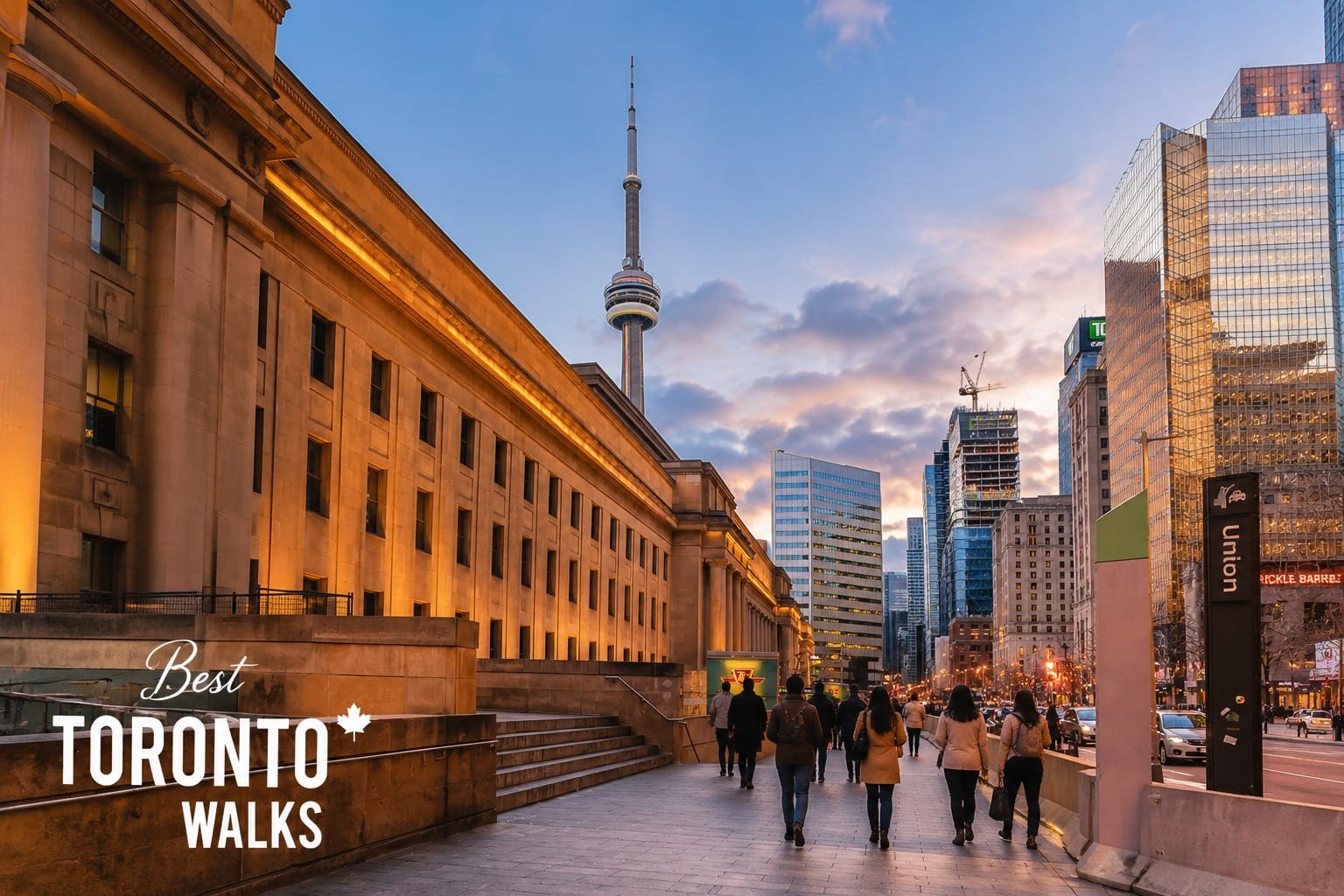
Toronto rewards people who walk it. The downtown core is unusually compact, you can go from the CN Tower to the Royal Ontario Museum in about 25 minutes on foot, and almost everything worth seeing sits within a handful of connected neighbourhoods rather than scattered across a sprawling map. That compactness is exactly why walking, rather than the subway or a rideshare, tends to be the best way to actually get a feel for the city.
The City of Toronto backs this up directly. Through its Self-Guided Tours program, it offers 49 free walking routes covering architecture, nature, and individual neighbourhood main streets, all downloadable at no cost. You do not need an app, a guide, or a booking, just a decent pair of shoes and a rough plan for the day.
The One Walk First-Timers Should Do
If you only have one day, the Downtown Toronto Highlights route is the obvious starting point. It loops through Nathan Phillips Square and Old City Hall, continues into Old Town past the Flatiron Building and St. Lawrence Hall, and can be extended into the Distillery District’s cobblestone lanes. Most people cover the core loop in two to three hours at an easy pace, though it is easy to stretch it into a half-day if you stop for the St. Lawrence Market or linger in the Distillery District.
The route conveniently starts and ends near several subway stations, Union, St. Andrew, Osgoode, and Queen are all within a few minutes of the path, which means you can join partway through or split the walk across two shorter outings if a full loop feels like too much in one go. Along the way, small parks like Berczy Park and Simcoe Park offer good rest points, and Berczy Park’s dog fountain has become something of an unofficial landmark in its own right.

Toronto’s downtown core is unusually walkable, and the city’s own self-guided tour maps are free, detailed, and easy to follow without an app.
If these routes are part of a longer Toronto trip you are still planning, it helps to lock in flights before hotel rates climb closer to your dates. Find the Best Flight Deals to Toronto and build your walking itinerary around whichever days you land.
Heritage Toronto’s Saturday Walks
For a guided experience without paying for one, Heritage Toronto, the city’s heritage advocacy organization, runs free volunteer-led walks every Saturday from April through October. These cover history, architecture, and natural areas, and they consistently rank among the best guided experiences in the city precisely because the guides are local history enthusiasts rather than commercial tour operators. If you are visiting on a Saturday during that window, it is worth checking their schedule before booking anything else.
Tip-based walking tours run year-round as well, typically in the $20 to $30 range per person, and cover everything from Old Town’s rebellion-era history to the street art of Graffiti Alley on Queen Street West. These tend to run daily, several times a day, so they are easy to slot into a trip on short notice, and most last around 90 minutes to two and a half hours depending on the route.


Themed Routes Worth Seeking Out
- Graffiti Alley: A constantly changing stretch of murals behind Queen Street West, with stories ranging from Indigenous reclamation art to guerrilla protest pieces
- Public art walk: A route through downtown galleries and outdoor installations, good for a rainy-day version of a walking tour
- St. Lawrence and Old Town: Focused on the neighbourhood’s role in Toronto’s founding, including stops connected to the 1837 rebellion
For visitors who would rather book a themed walk online ahead of time instead of choosing on the spot, Explore Local Experiences to see guided options across Old Town, the Distillery District, and the waterfront before you land.
Beyond Downtown: Nature, Neighbourhoods, and the Waterfront
Walking in Toronto is not limited to the downtown core. Kensington Market rewards a slow wander through its painted storefronts and food stalls, and it works well with kids thanks to shorter distances between stops. The waterfront path along Queens Quay, with HTO Park and the Toronto Islands ferry terminal along the way, is another strong option, especially in warmer months. For something longer and greener, the Martin Goodman Trail runs end to end along the shoreline and can fill a full day, six to eight hours, for anyone who wants a proper hike within city limits.
High Park, nearly 400 acres of trails, gardens, and a small zoo, is worth a half-day on its own, particularly in spring when its cherry blossoms draw crowds. The Leslie Street Spit, officially Tommy Thompson Park, is a man-made peninsula good for birdwatching and skyline views, though note it is only open on weekends and holidays. Further east, the Beaches boardwalk offers a quieter, more residential stretch of waterfront walking, popular with locals rather than tour groups, and pairs well with a coffee stop along Queen Street East.
Building a Multi-Day Walking Itinerary
For visitors staying more than a day or two, it is worth layering routes rather than repeating the same downtown loop. A reasonable structure looks like: day one for the Downtown Highlights and Old Town, day two for Kensington Market and the Annex’s Edwardian houses, and day three for the waterfront and, if the season allows, a ferry over to the Toronto Islands to close out the trip on a quieter note.
Practical Notes Before You Set Out
Comfortable shoes matter more in Toronto than in most cities, mainly because of the cobblestones in the Distillery District and the sheer distance covered by the longer routes. Layered clothing helps too, since lake-effect weather near the waterfront can feel noticeably cooler than a few blocks inland. Doors Open Toronto in May and the Distillery Winter Village in December are both worth timing a trip around if your schedule allows it, since both events add a layer of programming on top of the walking routes themselves.
Frequently Asked Questions
Do I need to book the free city tours in advance?
No. The self-guided maps are simply downloaded from the City of Toronto’s website and followed at your own pace, with no booking required.
Are the walking tours suitable in winter?
Most routes remain walkable year-round, though some nature-focused trails can be icy, and shorter daylight hours in winter mean starting earlier in the day.
- Download the City of Toronto’s self-guided maps before you go, cell signal can be patchy inside some older buildings and underground PATH sections
- Union Station, St. Andrew, Osgoode, and Queen subway stations all sit along the Downtown Highlights route, so you can start or stop the walk at any of them
- Heritage Toronto’s Saturday walks fill up, arrive a few minutes early rather than right at the start time
- Bring a portable charger if you are relying on a phone map for a full-day route
For a broader sense of the neighbourhoods these walks pass through, Wikipedia’s entry on Old Toronto is a useful reference for the historical layer beneath the modern city, and it pairs well with the City of Toronto’s own self-guided tours page if you want the practical route maps to go with the history.
Guided vs. Self-Guided: Which Fits Your Trip
Self-guided routes suit travelers who prefer to set their own pace, linger at a mural or a storefront, and skip sections that do not interest them. Guided tours, whether the free Heritage Toronto walks or the tip-based commercial options, suit anyone who wants context delivered in real time rather than read off a phone screen between stops. Neither approach is objectively better, and many visitors end up mixing both, a guided walk on the first day to get oriented, followed by self-guided routes once the layout of downtown starts to feel familiar.
Groups with mixed interests tend to do well with this hybrid approach too. A guided history walk in the morning followed by a self-guided afternoon through Kensington Market lets everyone get what they want out of the day without forcing a single pace on the whole group.
A Practical Note From Experience
The biggest mistake I have seen visitors make with Toronto’s walking routes is trying to cram too many neighbourhoods into a single day. The Downtown Highlights loop alone rewards a slower pace than its stated two to three hours suggests, especially once you factor in a market stop or a coffee break. Splitting ambitious plans across two shorter walks, rather than one long forced march, consistently produces a better day and better photos, since rushed visitors tend to miss the small details, a carved doorway, a quiet courtyard, that make Toronto’s older neighbourhoods worth walking in the first place.