
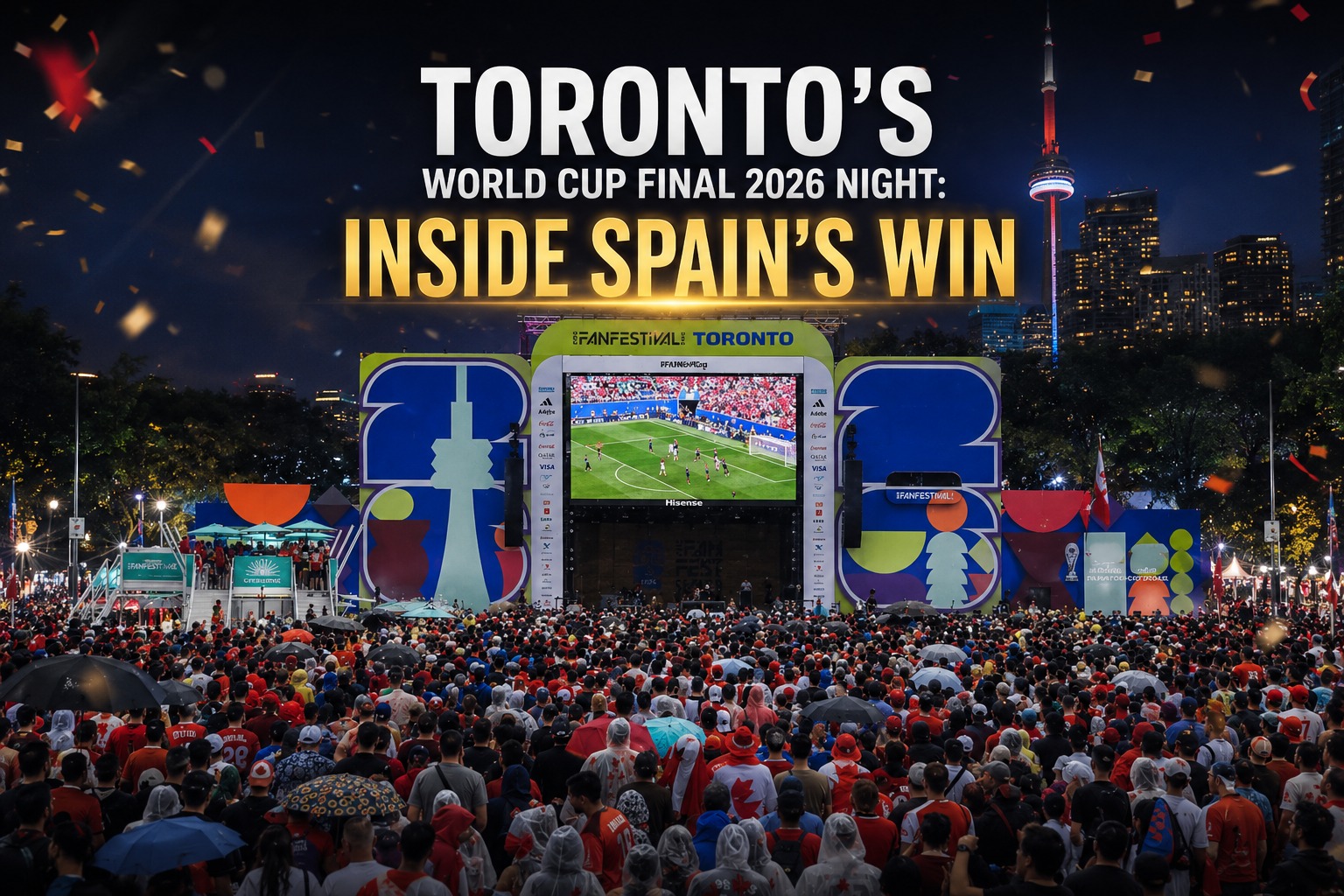
Toronto’s World Cup Final Night: Inside Spain’s Win
Toronto never hosted the final itself, but on the night Spain beat Argentina, the city produced one of the loudest, strangest, most unforgettable evenings of its World Cup summer.

By nine o’clock on Sunday night, Fort York smelled like grilled corn, spilled beer, and forty thousand people who had been standing in the sun for six hours. Someone near the fountain stage had a Spanish flag painted across their entire back. Somebody else, a few metres over, was still wearing an Argentina number ten, jaw clenched, refusing to sit down. Toronto did not host the World Cup final. It was never going to. But it watched that final harder than almost anywhere outside New Jersey, and by the time Ferran Torres put the ball in the net, the noise coming off the Bentway sounded like the city had scored itself.
This is the story of how Toronto experienced the night Spain became world champion for the second time, where the city gathered to watch, what the mood was like as the match dragged into extra time, and why a tournament that never touched a Toronto final still left a genuine mark on the city.
Toronto did not host the 2026 World Cup final. That match was played at MetLife Stadium in East Rutherford, New Jersey, where Spain beat Argentina 1-0 in extra time on a goal from substitute Ferran Torres. Toronto’s role was as a host city earlier in the tournament, staging six matches, and as the site of one of the largest fan celebrations in the country, centred on the FIFA Fan Festival at Fort York and The Bentway.
Where Toronto Watched the Final
For thirty-nine days, the FIFA Fan Festival at Fort York National Historic Site and The Bentway had been the unofficial living room for Toronto’s World Cup summer, and on final day it filled up faster than any match screening before it. General admission was free, but by mid-morning the online ticket allocation for the final had already been claimed, and the line along Fort York Boulevard stretched well past the Gate 1 entrance. Inside, the main screen sat framed by the same 1812-era ramparts that have watched over the site for more than two centuries, which made for one of the odder juxtapositions of the summer: a historic military fort, repurposed into the loudest soccer bar in the country.
Did I need a ticket to watch the final in Toronto?
At the official Fan Festival, yes, a free reserved ticket was required and those went quickly. Plenty of no-ticket alternatives existed too, including Stackt Market, which let in up to 1,200 fans a day on a first-come basis, and dozens of restaurant and community watch parties across the city that needed nothing more than showing up.

A short walk away, Nathan Phillips Square told a different version of the same story. The pop-up soccer pitch that had occupied the square since June, a joint project between the city and Visa, turned the space in front of City Hall into an unlikely training ground for kids all summer. On final day it became something closer to a block party, with families spreading blankets in front of a screen while the Toronto sign glowed behind them. The city has said the pitch will move to a permanent home once the tournament wraps up, though where exactly has not been confirmed yet.
Further west, Humber College’s Lakeshore campus ran its own Match Day Hub through the tournament, and in Etobicoke and Scarborough, community centres leaned into the moment with events built around specific neighbourhoods rather than the downtown crowd. Little Jamaica’s Reggae Lane hosted a public viewing as part of its Multiculturalism Day programming, and the Chinese Cultural Centre of Greater Toronto opened its 1,200-seat hall for free screenings as part of a five-week series called One City, One Game, Many Cultures. If there was a single theme to how Toronto watched this final, it was that no single venue owned the night. The city just found forty different rooms to be loud in at once.
Flying in for a future Toronto match weekend or planning next summer’s trip around the sport calendar? It is worth comparing fares before your dates lock in.
Compare flight prices →The Match Itself, As Toronto Saw It
Anyone who has watched a scoreless final knows the specific tension that builds when neither team blinks. Spain controlled the pace for most of the match the way they had all tournament, patient in possession, quick in the final third, but Argentina’s goalkeeper kept finding a way to get in front of everything. At Fort York, every save drew a groan from one half of the crowd and a roar from the other, and by the time ninety minutes ended scoreless, the fort’s ramparts were doing very little to contain the noise spilling into the surrounding streetcar tracks.
Extra time changed the temperature completely. Ferran Torres, on for barely twenty minutes, met a cross from Lamine Yamal and buried it in the 105th minute, and the screen at Fort York genuinely shook the ground under people’s feet for a second. Fans in Messi jerseys, and there were a lot of them in a city with one of the largest Argentine communities in Canada, went quiet in a way that felt different from a normal loss. Messi has said this is likely his last World Cup, and there was a sense at the watch parties that people understood they were watching something end, not just a match.
It was the strangest kind of silence, thousands of people who had been screaming for two hours all at once holding their breath. — overheard near the main stage, Fort York
By the time the final whistle blew, Spain had become the first champion in World Cup history to win the tournament while conceding only a single goal across the entire run, an eight-match gauntlet under the expanded 48-team format. For a Toronto crowd that had spent six weeks getting used to a World Cup on its own doorstep, that scoreline landed as confirmation of something people had already sensed watching Spain move through the group stage: this was simply a better team, night after night.
Why Toronto’s World Cup Felt Different
Toronto hosted six matches at BMO Field, rebranded Toronto Stadium for the tournament, making it one of sixteen host cities spread across the United States, Mexico, and Canada, the first time the men’s World Cup has been shared across three countries. That host status is really what shaped the entire summer, because it meant Toronto built out fan infrastructure, transit partnerships, and neighbourhood programming as if a final might land here, even once the bracket made clear it would not.

That groundwork is part of why the city’s celebration felt bigger than a normal viewing party. GO Transit ran expanded weekend service specifically for match days, with fare promotions designed to get fans out of their cars and onto trains headed downtown. If you are planning any future trip around a major Toronto sporting event, the same logic applies well beyond soccer: skip the parking search entirely and let transit absorb the crowd surge for you.
The multicultural framing mattered too. Toronto has long marketed itself around the idea of being “The World in a City,” and this tournament gave that slogan an actual stress test. Watch parties built specifically around Little Jamaica, Chinatown, and a few other cultural hubs were not an afterthought bolted onto the main Fan Festival. They ran as their own standalone events with their own audiences, and for a lot of residents, that was the more meaningful World Cup experience than anything happening downtown.
Getting to a Watch Party
GO Transit and the TTC both ran extended service on match days. Downtown venues near Fort York were walkable from Union Station in under fifteen minutes.
Best Areas for a Loud Crowd
Little Portugal, Corso Italia, and Roncesvalles have long histories as unofficial soccer neighbourhoods, and they leaned into the final hard, independent of any official programming.
What Sticks Around
The Nathan Phillips Square pitch is relocating permanently, and several community centres have said they intend to keep some version of their viewing programming for future tournaments.
If the final made you want to see more of the city that hosted it, our guide to things to do in Toronto is a good next stop, and Fort York itself sits along one of the routes covered in our self-guided walking routes through the city’s key neighbourhoods, both worth bookmarking if a Toronto trip is on your radar.
Will Toronto host World Cup matches again?
Nothing has been confirmed, but hosting six matches in 2026 and building this scale of fan infrastructure typically strengthens a city’s case for future major tournaments, including a possible Women’s World Cup bid down the line.
Quick Facts
- 2026 World Cup champion
- Spain (2nd title)
- Final score
- Spain 1, Argentina 0 (AET)
- Winning goal
- Ferran Torres, 105th minute
- Toronto’s tournament role
- Host city, 6 matches at BMO Field
Want to build a Toronto trip around its stadiums, neighbourhoods, and waterfront in a future football season?
Explore tours and experiences →Tips & FAQ
Common questionsDid Toronto host the 2026 World Cup final?
No. The final was played at MetLife Stadium in East Rutherford, New Jersey, where Spain beat Argentina 1-0 in extra time. Toronto’s part in the tournament came earlier, as one of the sixteen host cities.
Where did people in Toronto watch the World Cup final?
The largest official gathering was the FIFA Fan Festival at Fort York and The Bentway, with major crowds also at Nathan Phillips Square, Stackt Market, Harbourfront Centre, and neighbourhood watch parties across the city.
How many matches did Toronto host in the 2026 tournament?
Toronto hosted six matches at BMO Field, which was renamed Toronto Stadium for the duration of the World Cup.
Who won the 2026 FIFA World Cup?
Spain won its second World Cup title, defeating Argentina 1-0 after extra time thanks to a goal from substitute Ferran Torres.
Is the soccer pitch at Nathan Phillips Square staying?
The City of Toronto has said it plans to relocate the pop-up pitch to a permanent site after the tournament, with details expected to follow.
Toronto’s World Cup ends the way most of a host city’s tournaments do, not with the final whistle of the final match, but with a city quietly proud of the six weeks it just pulled off. Save this guide if you are planning a future trip around Toronto’s sports calendar, and if it is useful, pass it along to anyone else who spent their summer chasing watch parties around the city.
Safe travels — TorontoBook