

When Does the Toronto Stock Exchange Open?
TSX trading hours, pre-market and after-hours windows, and the 2026 holiday calendar.
If you have ever pulled up a Canadian stock quote at 8 a.m. and wondered why nothing seems to be moving, the answer is simple: the market has not opened yet. The Toronto Stock Exchange (TSX), Canada’s primary equities exchange and one of the largest exchanges in the world by market capitalization, runs on a fixed daily schedule, Monday through Friday, with a handful of holiday closures sprinkled through the year.
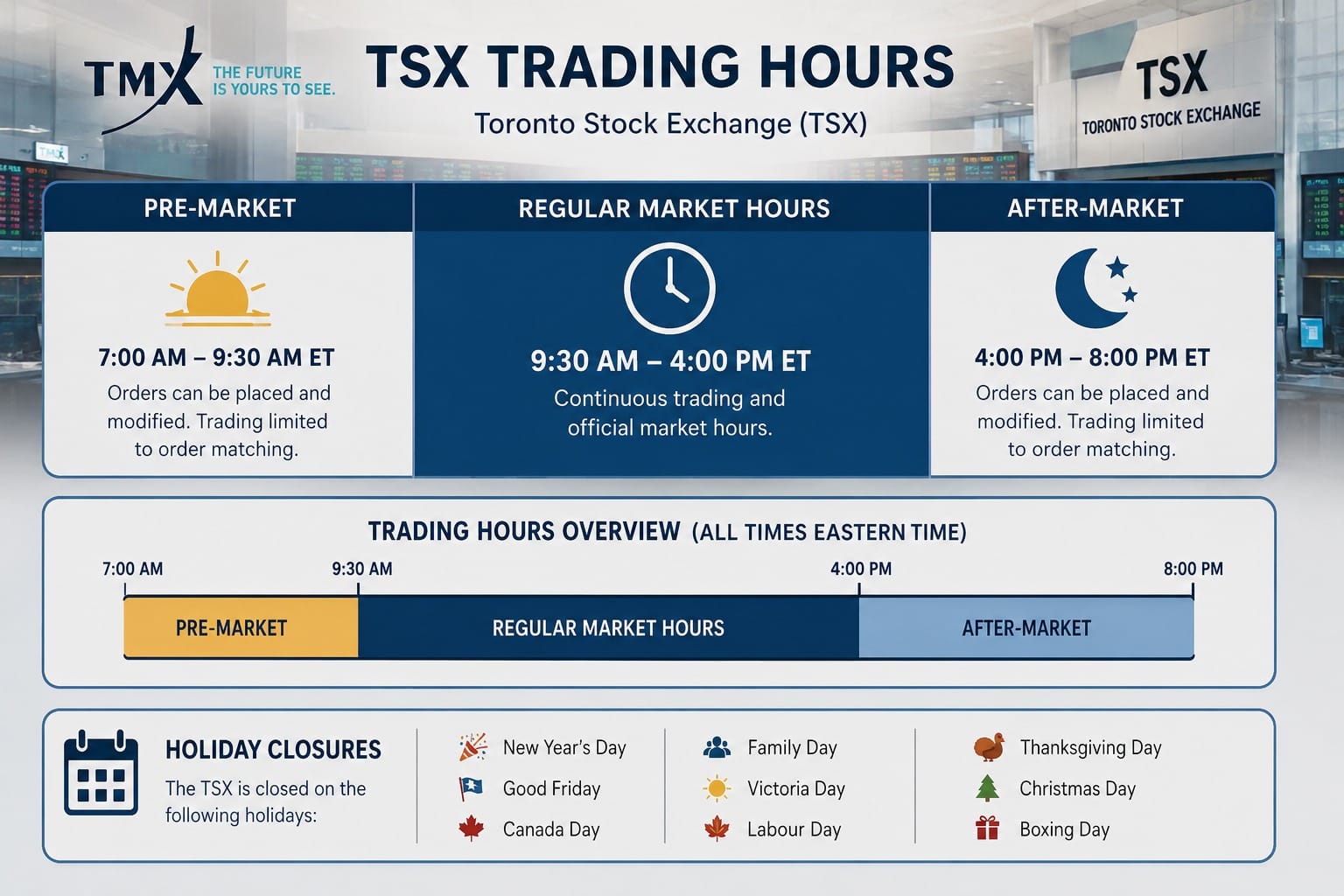
Regular trading hours are 9:30 a.m. to 4:00 p.m. Eastern Time, the same core session used by the New York Stock Exchange and Nasdaq. That overlap is not a coincidence. It keeps Canadian and U.S. markets moving in sync for most of the trading day, which matters if you are watching cross-listed stocks or ETFs that trade on both sides of the border, or if you are trying to time a trade around a U.S. economic release that lands mid-morning.
If you are traveling to Toronto for business tied to Bay Street or the exchange itself, it is worth booking your flight around the regular session rather than around holiday closures, since Pearson traffic and hotel rates both climb on TSX-heavy conference weeks. Search Cheap Flights Today to compare fares before locking in dates.
Pre-Market and After-Hours, in Plain Terms
Extended trading exists on the TSX just as it does on U.S. exchanges, typically a pre-market window starting around 7:00 a.m. and an after-hours session running to around 5:00 p.m., though exact extended-hours availability depends on the specific brokerage or trading venue you use. These windows can be useful if news breaks outside regular hours, say an earnings report drops after 4 p.m., since they let traders react before the next full session opens.
That said, extended hours come with real trade-offs. Liquidity is thin outside the 9:30 to 4:00 window, meaning fewer buyers and sellers are active, so prices can swing more sharply on smaller volumes. Many extended-hours venues only accept limit orders, not market orders, and not every stock is available to trade at all during these windows. It is a useful tool, not a substitute for the regular session, and traders who rely on it heavily tend to build in wider price tolerances to account for the thinner order books.
Why the Opening and Closing Minutes Matter
The first and last few minutes of the regular session tend to see the heaviest volume of the day. The opening auction absorbs overnight order flow and sets the tone for the session, while the closing auction is often used by index funds and institutional traders to align their holdings with end-of-day benchmarks. If you are a casual investor placing a market order, it is worth knowing that prices can be more volatile in these windows than during the calmer stretch of the mid-afternoon session.
2026 Holiday Closures to Plan Around
The TSX follows a published annual holiday calendar, and it is worth checking before you plan any trade around a long weekend, since the exchange closes completely on these dates rather than running a shortened session in most cases. A few of the confirmed full-day closures for 2026 include the Civic Holiday on Monday, August 3, Labour Day on Monday, September 7, the National Day for Truth and Reconciliation on Wednesday, September 30, Thanksgiving on Monday, October 12, and Christmas Day on Friday, December 25.
| Holiday | 2026 Date |
|---|---|
| Civic Holiday | Monday, August 3 |
| Labour Day | Monday, September 7 |
| National Day for Truth and Reconciliation | Wednesday, September 30 |
| Thanksgiving (Canada) | Monday, October 12 |
| Christmas Day | Friday, December 25 |
Beyond these dates, the TSX also observes closures common to most North American exchanges, such as New Year’s Day and Good Friday, and it publishes roughly 30 holiday and special-schedule notices per year once shortened sessions and settlement notes are included. None of this is exotic information, but it is scattered enough across different sources that it is easy to get a date wrong if you are working from memory rather than the exchange’s own calendar.
The full, current holiday calendar and any settlement notes for U.S.-dollar listings are maintained directly by TMX Group, the TSX’s parent operator, and are worth bookmarking rather than relying on memory.
How TSX Hours Compare to Other Major Exchanges
Because the TSX shares its core session with the NYSE and Nasdaq, most Canadian investors do not need to think much about time zone conversion when trading U.S.-listed securities. The picture changes for anyone also watching European or Asian markets. The London Stock Exchange’s morning session overlaps only briefly with the TSX’s open, and Tokyo’s session has already closed hours before Toronto even opens. For investors managing a genuinely global portfolio, this means TSX-listed Canadian equities are really only “live” alongside U.S. markets, not alongside Europe or Asia.
A Quick Note on the TSX Venture Exchange
The TSX Venture Exchange, aimed at smaller and early-stage companies, runs on the same 9:30 to 4:00 schedule as the main board. If you hold or trade TSXV-listed securities, the hours and holiday calendar you need to track are identical to the ones covered here, which simplifies things for anyone splitting a portfolio between the two boards.
For anything related to your flight itself, changes, cancellations, or airline contact information ahead of a Bay Street trip, TorontoBook.com keeps practical airport and airline details in one place.
Where to Verify the Schedule Yourself
Trading hours occasionally shift for special circumstances, and holiday lists are set well in advance but still worth double-checking close to your trading date. The most reliable source is the exchange’s own Calendars & Trading Hours page on tsx.com, which lists the current year’s holiday schedule and any special settlement notes for cross-border listings. For background on the exchange itself, its history, and how it fits into the broader TMX Group, Wikipedia’s entry on the Toronto Stock Exchange is a useful overview.
I have sat through more than a few mornings watching a Canadian ticker sit motionless before 9:30, convinced something was wrong with my data feed, only to realize the market simply had not opened yet. The lesson that stuck with me is a simple one: official hours are a starting point, not a guarantee, and confirming the exchange’s own calendar before a holiday week saves you from staring at a frozen quote wondering what happened. Official notices and personal experience tend to agree here more often than not, but the exchange’s own page is still the tiebreaker whenever a date looks uncertain.
Frequently Asked Questions
Does the TSX ever run a shortened session?
Yes, certain days around major holidays occasionally see early closes, and these are flagged in advance on the official calendar rather than announced same-day.
Can I trade TSX stocks outside Canada?
Most international brokerages offer access to TSX-listed securities, though hours and available order types during extended sessions vary by broker rather than by the exchange itself.
- The TSX and TSX Venture Exchange share the same 9:30–4:00 core session
- Some U.S. holidays trigger special settlement rules for USD-denominated TSX listings, even when the exchange itself stays open
- Always confirm hours around Canadian long weekends, since the TSX closes fully rather than running a half day for most holidays
- Volume and volatility are typically highest in the first and last 15 minutes of the regular session
How Settlement Timing Fits Into the Picture
Trading hours are only half the story for anyone actually managing a Canadian brokerage account. Trades executed on the TSX generally settle on a T+1 basis, meaning the trade finalizes one business day after the transaction, a standard shared with most North American exchanges following the industry-wide shift to faster settlement. Holiday closures affect this timeline directly, since a trade placed the day before a full market closure will settle a day later than it would on a normal week. This matters most around long weekends, when a Friday trade might not fully settle until the following Tuesday.
For anyone new to Canadian markets, it is worth remembering that settlement rules and trading hours are tracked separately by TMX Group, and neither one substitutes for financial advice tailored to your own account and broker. This article covers scheduling only, not investment guidance, so always confirm specifics with your brokerage before making time-sensitive trades.
A Practical Habit Worth Building
The simplest way to avoid confusion around TSX hours is to keep a single reference point rather than trying to remember exceptions. Bookmarking the exchange’s own calendar page and checking it once a week, or before any trade tied to a holiday-adjacent date, removes almost all the guesswork. It is a small habit, but it is the difference between confidently placing an order and wondering, mid-morning, why the market still looks closed.