
Paris Landmarks: A Traveler's Guide to the City's Icons
Every city has monuments. Paris has moods. The Eiffel Tower looks different at 7am than it does at midnight, the Louvre feels like a different building on a Tuesday than on a Saturday, and Notre-Dame today is not the cathedral your parents visited. This guide walks through the landmarks that define Paris, with the practical details that decide whether your visit feels effortless or exhausting.

Quick Facts Before You Go
- Best time to visitApril, May, September, October
- CurrencyEuro (EUR)
- LanguageFrench
- Getting aroundMetro, walking, Velib bikes
- Time needed for landmarks3 to 4 full days
- Average daily budget90 to 160 EUR per person
Why Paris Landmarks Still Surprise First Time Visitors
Photographs prepare you for the shape of things. They do not prepare you for the scale. The Arc de Triomphe looks modest in pictures and enormous in person. The Louvre looks like one museum from the outside and reveals itself as a small city of galleries once you step in. Sainte-Chapelle looks like a plain stone chapel from the street, then opens into a room made almost entirely of stained glass.
That gap between expectation and reality is the real reason people fall for Paris. This guide is built around closing that gap before you land, so the surprises you experience are the good kind: the light on the Seine at golden hour, the smell of fresh bread near Sacre-Coeur, the quiet moment inside Notre-Dame once the tour groups move on.
Planning the flights first makes everything else easier to schedule around. Compare Flight Prices Before You Book so you know your arrival window and can build the rest of the itinerary from there.
The Landmarks Worth Your Time
Paris has far more monuments than any single trip can cover well, so the sections below are organized as short, focused reads. Tap a title to open it, and close it again once you have what you need. This is not a checklist to rush through. It is a shortlist of the places that reward the time you give them.
The Eiffel Tower: Still the Best First Stop
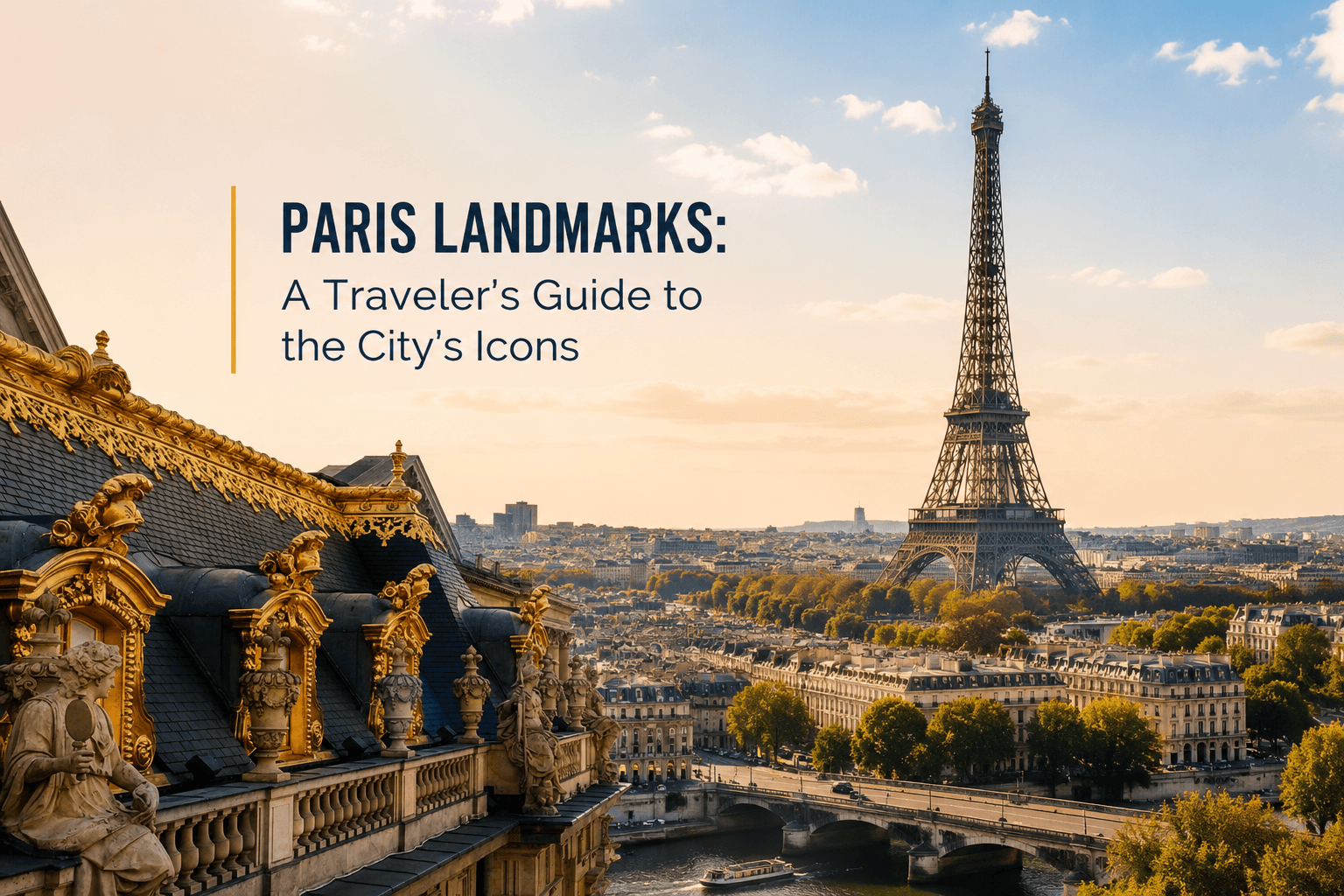
Gustave Eiffel's tower was meant to stand for twenty years before being dismantled. Instead it became the symbol most people picture when they hear the word Paris. Built for the 1889 World's Fair, it was controversial in its own time and is now the most visited paid monument on earth.
The best experience is rarely the summit. The second floor offers views that are arguably more useful for photography, since you can still make out landmarks at street level, and the lines are shorter. Arriving right at opening or an hour before sunset gives you softer light and thinner crowds. Booking a timed entry online in advance is worth the small effort, since walk-up queues in peak season can run past two hours.
For the classic postcard shot, cross the Seine to Trocadero. For a quieter, more local angle, the Champ de Mars gardens below the tower are a good spot for a picnic once the afternoon crowds thin out.
The Louvre: How to See It Without Losing a Day to Lines
The Louvre holds roughly 35,000 works on display at any given time, spread across a building that used to be a royal palace. Nobody sees all of it in one visit, and trying to is the fastest way to leave exhausted and unsatisfied.
Pick three or four things you actually want to see, such as the Mona Lisa, the Winged Victory of Samothrace, the Venus de Milo, and one wing that matches your own interests, whether that is Egyptian antiquities or French Romantic painting. Book a timed ticket online rather than joining the queue at the glass pyramid, and consider entering through the smaller Carrousel du Louvre entrance, which tends to move faster.
Wednesday and Friday evenings, when the museum stays open later, are noticeably calmer than weekend afternoons.

Notre-Dame Cathedral: What It Looks Like After the Fire
Notre-Dame reopened to the public on December 7 and 8, 2024, after five years of restoration following the 2019 fire that destroyed its spire and roof. The rebuilt interior has drawn near universal praise, with cleaned stonework, restored rose windows, and a rebuilt spire that closely follows the 19th century design by Viollet-le-Duc.
Entry to the nave remains free, as with all cathedrals in France, but a free timed reservation through the official site is strongly recommended during spring and summer to avoid long waits. Walk-ins are still accepted, just with less predictable queue times. The bell towers, separate from the main cathedral, reopened in September 2025 with paid tickets and a genuine 422 step climb, so plan for that as a distinct activity rather than an add-on.
Thursday evenings, when the cathedral stays open until 10pm, tend to be the quietest window for a calmer visit.
Sainte-Chapelle: The Landmark Most Visitors Skip
A short walk from Notre-Dame, Sainte-Chapelle is easy to miss because its exterior gives no hint of what is inside. The upper chapel is essentially a cage of stained glass, with fifteen towering windows depicting over a thousand biblical scenes in glowing color. On a sunny afternoon, the effect is unlike anything else in Paris.
Combine it with the nearby Conciergerie, once a royal palace and later a Revolutionary era prison, for a half day covering three major sites within a few minutes' walk of each other.
Arc de Triomphe and the Champs-Elysees
Commissioned by Napoleon to honor his armies, the Arc de Triomphe now anchors one end of the Champs-Elysees, arguably the most famous avenue in the world. Climbing to the rooftop viewing platform gives one of the better panoramic views in Paris, since it includes the Eiffel Tower in the frame in a way the tower itself cannot.
The avenue below has shifted over the decades from purely luxury shopping toward a mix of flagship stores, cinemas, and cafes, so it rewards a slow walk rather than a rushed one. Traffic circles Place Charles de Gaulle constantly, so use the underground pedestrian tunnel to reach the arch safely rather than attempting to cross the roundabout on foot.

Sacre-Coeur and Montmartre: Paris From Above
Montmartre was once a village of windmills and vineyards outside the city, and it still feels separate from the rest of Paris in the best way. The Basilica of Sacre-Coeur sits at the top of the hill, its white stone visible from much of the city, and the steps in front of it are one of the most reliable free viewpoints in Paris.
Beyond the basilica, the neighborhood's narrow streets once housed Picasso, Van Gogh, and Renoir, and Place du Tertre still fills with working artists today. Go early in the morning to see the square before the tour groups arrive, and stay past sunset for the funicular ride down with the city lit up below.

A Few More Landmarks Worth Squeezing In
- Musee d'Orsay: Housed in a former railway station, home to the world's largest collection of Impressionist and Post-Impressionist paintings.
- The Pantheon: A domed mausoleum holding the remains of Voltaire, Marie Curie, and Victor Hugo, with a Foucault pendulum still swinging inside.
- Luxembourg Gardens: The city's most elegant public park, ideal for a slower afternoon between museum visits.
- Palais Garnier: The opulent opera house that partly inspired The Phantom of the Opera, open for daytime tours even without a performance ticket.
Getting Around Paris Without Wasting Half Your Day
Paris rewards visitors who use the Metro rather than fight the traffic above ground. The network covers the entire city with over 300 stations, and most landmarks sit within a ten minute walk of one. A carnet of paper tickets has been phased out in favor of the rechargeable Navigo Easy card, which is worth buying on day one at any station.
For day trips or airport transfers, the RER commuter rail connects to both Charles de Gaulle and Orly airports. Airport terminals can be confusing on a first visit, and gate changes or last minute flight adjustments are common enough that it helps to have a reliable reference on hand. TorontoBook.com is a useful resource for airline office information and flight change guidance if your travel plans shift.
A Realistic Three Day Landmark Itinerary
Day One: The Icons
Eiffel Tower at opening, lunch near Champ de Mars, Arc de Triomphe and a walk down the Champs-Elysees in the afternoon.
Day Two: The Island and the Museum
Notre-Dame and Sainte-Chapelle in the morning, Louvre in the afternoon with a pre-booked timed ticket, evening stroll along the Seine.
Day Three: The Hill and the Details
Montmartre and Sacre-Coeur in the morning before the crowds, Musee d'Orsay or Luxembourg Gardens in the afternoon, free evening for a neighborhood you have not yet explored.
If museums and skip-the-line access matter to your itinerary, booking ahead removes one of the biggest sources of wasted time. Book Museum Tickets in advance for the Louvre or Musee d'Orsay so a full day of sightseeing does not start with an hour in line.
Budget Guide for Landmark Hopping
What to Expect Per Person, Per Day
- Budget traveler60 to 90 EUR
- Mid-range traveler100 to 160 EUR
- Comfortable traveler180 EUR and up
- Notre-Dame nave entryFree
- Louvre ticketAround 22 EUR
- Eiffel Tower summitAround 35 EUR
Museum passes can save money if you plan to visit four or more paid sites, but they rarely cover the Eiffel Tower or Notre-Dame towers, so check what is actually included before buying one.
Common Mistakes and What Official Warnings Actually Mean
Most travel advisories about Paris focus on pickpocketing near major landmarks, particularly on the Metro and around the Eiffel Tower and Sacre-Coeur. These warnings are accurate but often read as more alarming than the reality on the ground.
I have walked through the same crowded plazas that show up in government advisories many times, and the practical risk is almost always about carelessness rather than danger. Official warnings are written for the least prepared traveler in the worst case scenario, while most visits go by without incident once you keep bags zipped and in front of you in crowds. The one habit that has served me best is treating busy staircases and ticket queues, not dark alleys, as the moments to pay closest attention. If you take one thing from this, it is that the risk in Paris is rarely about where you are, it is about how distracted you are when you get there.
Beyond pickpocketing, the other common mistake is scheduling too many landmarks in one day. Paris punishes rushed itineraries with long lines and tired feet, while rewarding travelers who plan three or four solid sights per day with room to wander in between.
Frequently Asked Questions
Is Notre-Dame open to visitors in 2026?
Yes. The cathedral reopened in December 2024 after restoration and is fully open, with free entry to the nave. A free timed reservation is recommended during peak season, though walk-ins are still accepted.
How many days do I need to see the main Paris landmarks?
Three to four full days covers the major sights at a comfortable pace, without rushing the Louvre or skipping Montmartre entirely.
Should I book tickets in advance for the Eiffel Tower and the Louvre?
Yes, for both. Walk-up lines during peak season can run over two hours, while timed online tickets usually get you inside within minutes of your slot.
What is the best time of year to visit Paris landmarks?
Late spring and early autumn offer the best balance of pleasant weather and manageable crowds. Midsummer is the busiest and hottest stretch of the year.
Is it safe to visit Paris landmarks at night?
Major landmarks and the areas around them are generally well lit and busy well into the evening. Standard city precautions apply, particularly on quieter Metro lines late at night.
Save This Guide for Your Trip
Pin this guide to your Paris travel board so it is ready when you start booking, and come back to it once you land.
Search Cheap Flights TodayParis does not need to be conquered in one trip. Most travelers who fall in love with the city are the ones who see fewer landmarks properly rather than more of them quickly. Pick your list, book your key tickets ahead of time, and leave room to get pleasantly lost between the ones you planned.